
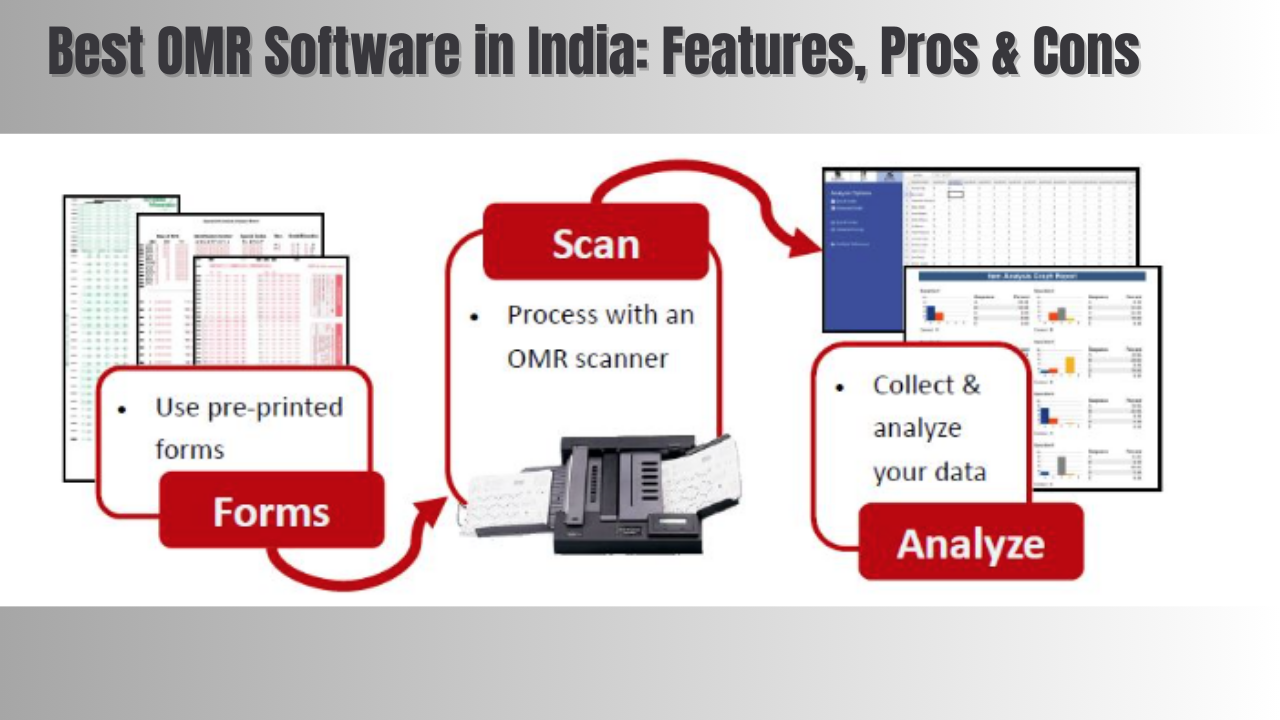
According to the Ministry of Education (Govt. of India), more than 3.5 crore students appear in national and state-level entrance exams every year. Additionally:
• NTA alone conducts exams for over 1.2 crore candidates annually across JEE, NEET, CUET, UGC NET, and others.
• State Public Service Commissions and recruitment boards conduct 50+ lakh OMR-based exams every year.
• Coaching institutes in India serve nearly 2.1 crore students (as per KPMG Education Report), many of whom require frequent OMR-based practice tests.
• According to MarketWatch & Global News Wire, the OMR software market is projected to grow at a CAGR of 8.5% between 2024–2030, reaching USD 1.86 billion.
With the massive rise in exam volume, institutes and exam authorities are moving away from manual checking because:
• Manual evaluation has an average error rate of 10–12%
• OMR software reduces errors to less than 0.5%
• Automated systems are 20–30× faster than manual evaluation
• Digital evaluation reduces operational cost by 40–60%.
Because of these factors, OMR technology has become a critical infrastructure component for universities, coaching institutes, recruitment boards, and corporate assessment teams.
Top 5 Types of OMR Solutions Used by Institutions in India
Instead of naming competitors, here are the five major categories of OMR evaluation tools used by exam bodies and institutes.
1. YOMARK by Yoctel (India)
India’s Leading OMR & Assessment Technology
Overview
YOMARK is one of India’s most advanced, accurate, and widely trusted OMR software platforms. Designed by Yoctel—an education technology company with 20+ years of experience—it is used across coaching centres, schools, universities, government exam bodies, and corporate hiring teams.
Key Solutions
• OMR reading via any flatbed/ADF scanner
• High-accuracy detection for light/partial marks
• Multiple question-type support
• Result processing with analytics
• OMR sheet design & printing support
• Cloud-based publishing
• Multi-centre exam consolidation
• Export to Excel, PDF & ERP
Pros
• Works with any scanner
• Fast bulk processing
• Deep performance analytics
• Accurate detection algorithms
• Student-wise, batch-wise reporting
Cons
• Requires basic training for operators
• Desktop-based (cloud extension available)
2. Basic OMR Scanning Tools (Entry-Level)
Overview
These entry-level tools provide basic OMR reading for small batches of sheets.
Pros:
• Affordable
• Easy for beginners
Cons:
• Limited reporting & analytics
• Lower accuracy
• Not suitable for large exam volumes
3. Cloud-Based OMR Platforms
Overview
Cloud OMR platforms allow scanning + evaluation + publishing online, suitable for distributed teams.
Pros:
• Remote accessibility
• Easy student access to results
Cons:
• Slower than local desktop processing
• Limited customisation for complex exams
4. Automated Exam Management Suites
Overview
Large exam authorities sometimes use integrated exam suites that include OMR reading, centre management, admit cards, and result generation.
Pros:
• End-to-end exam operations
• Good for multi-centre exams
Cons:
• Expensive
• Complex deployment
5. Custom In-House OMR Tools
Overview
Some institutions build basic internal OMR tools, mainly for small in-house assessments.
Pros:
• Tailored for internal needs
Cons:
• Low scalability
• Limited accuracy
• No analytics
Comparison of OMR Solution Categories
YOMARK OMR Software: Feature Deep Dive
Conclusion
Institutions across India are rapidly shifting to automated evaluation, and OMR software has become the backbone of modern assessments.
While several types of OMR tools exist, YOMARK stands out for:
• 20+ years of expertise.
• High accuracy and speed.
• Compatibility with any scanner.
• Deep analytics & detailed reports.
• Custom sheet design support.
• Trusted by leading coaching institutes, universities & exam agencies.
If you’re looking for a reliable, scalable, and accurate OMR solution, YOMARK by Yoctel is clearly the best choice for professional exam evaluation.
